Casa da Ínsua: Where Time Stands Still
In the heart of Penalva do Castelo, the historic Solar dos Albuquerques seems to halt the flow of time. This remarkable estate is not only steeped in centuries of family tradition but also stands out as the only Portuguese member of the Paradores network.
Although most people know it simply as Casa da Ínsua, the property remains under the stewardship of one branch of the noble Albuquerque family. Tracing its roots back to the 16th century, it was João de Albuquerque e Castro, mayor of Sabugal, who commissioned the original residence in the parish of Ínsua. Today, only the chapel and the terrace survive from that first structure adapted over the years, yet clearly testifying to the enduring presence of the family within these walls.
The Casa da Ínsua we admire today took shape in the 1780s, thanks to Luís de Albuquerque de Melo Pereira e Cáceres, governor and captain-general of Mato Grosso in Brazil. His vision gave rise to a quintessentially Portuguese 18th-century architectural design, showcasing the refined tastes of the era.
The vast dimensions of the estate necessitated the construction of five gates at different elevations, each serving specific purposes for family, staff, and farm activities. These include the Mata, Meia-Laranja, Barato, and Sereia gates, as well as the imposing Main Gate, which now welcomes visitors to the property.
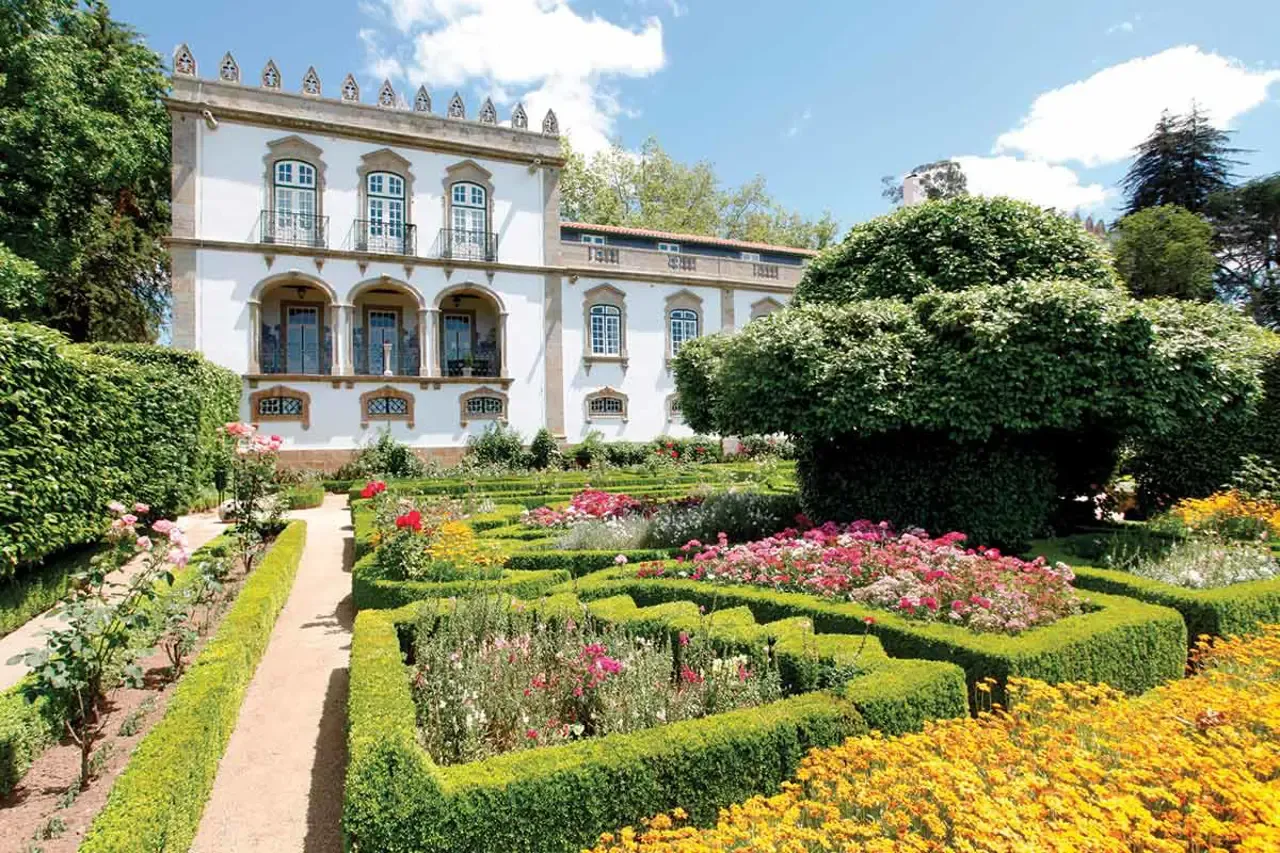
The central façade is striking by design and possesses an unusual feature: its main entrance does not lead directly into the house. Instead, the façade is divided into three parts—a middle section framed by two towers, each tower featuring a lovely three-arch loggia at the same level as the six French windows. One of the loggias is currently enclosed, but it still hints at the aesthetic ambition of its time. The roofs of the central structure and the towers are crowned by pentagonal battlements, now purely decorative, recalling an era when creativity in architecture was free from the threat of invasion.
The Wallpaper and Interiors
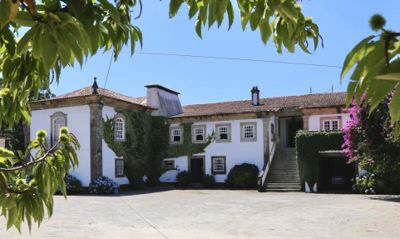
To step inside Casa da Ínsua, visitors must leave behind this impressive façade and proceed to the rear of the property. Here, an incomplete rectangular courtyard leads to the house’s main entrance, the chapel, and various ancillary buildings. The estate’s coat of arms, exhibiting the heraldry of Albuquerque and Pereira, adorns the north tower on the western side.
Upon entering, one is greeted by a grand hall distinguished by a monumental granite staircase. The eye is immediately drawn upward to the exquisite coffered ceilings, painted with the coats of arms of the Albuquerque, Melo, Pereira, and Cáceres families. These artistic ceilings, emblematic of 18th-century Portuguese style, continue throughout the house, including the elegant reception room—decorated with wallpaper attributed to Zuber, the same workshop that produced the paper for the renowned Casa de Sezim. This reception room was once the vibrant social hub of the estate, hosting visitors and festive gatherings alike.
The Portrait Room
One of the highlights is the Portrait Room, which houses a series of paintings depicting the various lords of Ínsua. Originally a manor house, Casa da Ínsua was considered indivisible and passed down to a single successor in each generation—often an uncle to a nephew, provided the nephew did not marry. Prominent among these portraits is the likeness of Luís de Albuquerque de Melo Pereira e Cáceres, the visionary behind the estate’s current design. Another noteworthy piece is the equestrian portrait of Francisco de Albuquerque e Castro, created by the learned painter Félix da Costa Meesen, famed for his manuscript Antiguidade da Arte da Pintura, a long-forgotten 17th-century treatise rediscovered in recent times.
Geometric Gardens and Rare Trees
Stepping into the gardens reveals the estate’s stunning landscaping. Nestled directly in front of the main façade lies the swan pond, named for its graceful residents. Two terraces of intricate boxwood designs showcase both the family coat of arms and decorative geometric motifs. Meanwhile, the English Garden boasts exotic brazilwood trees, likely brought over by Luís de Albuquerque de Melo Pereira e Cáceres following his tenure in Mato Grosso. Here, visitors will also find a towering eucalyptus—soaring to around 50 meters—and the charming Fonte dos Meninos, attributed to Nicola Bigaglia, who is said to have contributed to the home’s architecture and one of its gates.
A Devastating Fire and a New Chapter
In the late 1960s, Casa da Ínsua belonged to João de Albuquerque de Melo Pereira e Cáceres, but a devastating fire in 1970 destroyed the family library, erasing priceless documents related to their Brazilian heritage. Eventually, João de Albuquerque bequeathed the estate to his grandnephew, Vicente de Olazábal y Brito e Cunha.
Today, Casa da Ínsua remains in family hands, serving as a vibrant hub in its region. Converted into a distinguished hotel, it proudly stands as the only Portuguese member of the acclaimed Spanish** Paradores de Turismo **group. The estate continues to yield exceptional products, from jams and olive oil to Serra da Estrela cheese and the famous Casa da Ínsua wines of the Dão region—proving that, in this extraordinary corner of Penalva do Castelo, tradition endures and time truly does seem to stand still.