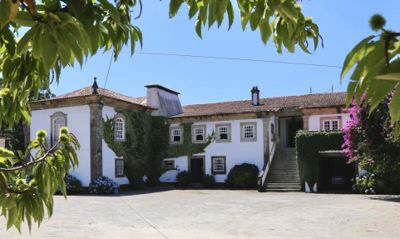
In Ponte de Lima, one of the rare medieval towers survives. Beyond its defensive role, it once served as a family residence. Today, it offers an incomparable tourist experience.
Torre de Refoios is the oldest and most remarkable house featured in this edition. Its construction dates back to the 13th century and is linked to the early days of Portugal’s history. It is a medieval tower and, at the same time, a house, a domus fortis, where the family still lives.
FOR THE DEFENSE OF FAMILY AND TERRITORY
In Portugal, a tower is normally associated with a defensive structure, but other meanings common in European territories are often overlooked, where towers and family castles expressed tensions, conflicts, and wars between local lords.
This tower is one of those examples. Defensive in structure but also residential, it was built by the “de Refoios” family, descendants of Afonso Ansemondes, to control the Lima River valley. A symbol of seigneurial jurisdiction, it embodied the military and administrative power of its lords.
Now surrounded by former agricultural annexes, probably built in the 17th century, it originally functioned as both a family seat and a military stronghold. It also incorporated agricultural structures that supported the cultivation of this fertile territory.
The Romanesque tower, divided into three floors, vertically organizes the typical layout of a manor house, which was usually arranged horizontally. The hall or great room was the first space at the entrance, where grand seigneurial receptions were held, followed by the chamber and the inner chamber, where the lord of the tower withdrew. In this tower, one can still see a utilitarian structure, the latrine, which, together with the arrow slits visible along the tower, forms the only openings in the complex. The absence of windows confirms that preserving the tower’s original defensive condition was a priority throughout the centuries.
To access the tower, one enters a courtyard that was possibly once enclosed by walls. There is a central door, elevated above ground level for defensive reasons, now reached by stone steps. As in the keeps of castles, access was originally made by a movable wooden ladder or ramp that, in the event of attack, could be removed. After passing through the three floors, one reaches the top, crowned by massive battlements. Attached to the tower were the kitchen and other service buildings which, in times of peace, served the family and the community associated with it.
Afonso Ansemondes was an important supporter of Dom Afonso Henriques in this region at the time of Portugal’s foundation. The king felt the need to surround himself with local lords who would recognize his claim to establish Portugal as a kingdom. In this process, he made his supporter a count and later granted the title to his son, Dom Mendo. Following the traditions of the time, he offered his lordship to the Augustinian friars for the foundation of a monastery.
A TOWER THAT ENDURED
Unlike other similar towers which, due to the passage of time and historical circumstances, were destroyed or incorporated into more modern residential complexes, this tower preserved its original form and structure.
After being integrated into the monastery, the property passed into the hands of the Canons Regular of Saint Augustine until, later, part of this lordship was separated and sold to Gonçalo Pires Cerqueira, a wealthy merchant who left it to his son Gaspar Malheiro. The Malheiro noble family did not assign it a residential function but an agricultural one, using it as a granary. In the 20th century, the tower was acquired by Dom José de Almada, son of the 5th Count of Almada, through his mother, Dona Maria Isabel de Abreu Coutinho, who inherited it from her grandfather, António de Magalhães Barros de Araújo Queirós, Lord of the Casa das Pereiras.
Today, the tower and part of its annexes are inhabited by this family, while another part is dedicated to rural tourism accommodation.